
Rosemary oil for hair growth is one of the most searched natural hair questions, and the short answer is honest, not hyped: rosemary oil has promising evidence from one small human trial, but it is not proven to regrow hair for everyone, and it is not a replacement for medical treatment for hair loss.
In plain words: if you have mild pattern thinning and you use diluted rosemary oil consistently for six months, the best available human evidence says you may see a similar hair-count improvement to 2% minoxidil in that one trial. If you have a smooth bald scalp, sudden shedding, or a medical cause of hair loss, rosemary oil alone is unlikely to fix it, and you should talk to a clinician first. This article is general information, not medical advice.
What the 2015 Rosemary Oil Study Actually Found
The claim behind almost every rosemary oil headline comes from one trial: Panahi et al., published in SKINmed in 2015.
That trial, in brief, was a randomized comparative trial in people with androgenetic alopecia, the medical name for pattern hair loss. One group applied rosemary oil to the scalp, the other applied 2% minoxidil, twice daily, for six months. Researchers measured hair count in a defined scalp area.
The results were:
- Both groups had a significant increase in hair count at three and six months compared with where they started.
- There was no statistically significant difference between the rosemary group and the minoxidil group in hair count.
- Scalp itching was reported in both groups, but it was significantly less frequent in the rosemary group than in the minoxidil group in the reports of that trial.
That is a real result, and it is also a limited result. Here are the limits you must know before you repeat the headline:
- It was one trial, with about 100 participants. It has not been repeated in a large trial since.
- It compared rosemary oil with 2% minoxidil, not the 5% formulation that is more commonly used today and has a much larger body of research behind it.
- It studied pattern hair loss only. It does not prove rosemary oil works for shedding caused by stress, illness, postpartum changes, thyroid problems, or nutritional deficiency.
- It does not prove rosemary oil regrows hair on a smooth, long-bald scalp, where follicles may no longer be active.
- The proposed mechanisms — improved scalp blood flow, antioxidant effects, and possible effects on the enzyme that converts testosterone to DHT — are studied mechanisms, not confirmed treatment effects in humans on their own.
So the honest verdict is: promising, single-trial evidence for mild pattern thinning, not proof of a cure, and not a like-for-like replacement for minoxidil for everyone.
How to Use Rosemary Oil for Hair Growth Safely
Never apply undiluted rosemary essential oil directly to your scalp. It is concentrated and can cause irritation, redness, or allergic reaction. Dilution is the rule, not an optional extra.
Exact Dilution to Start With
For most adults, a safe starting dilution is:
- Sensitive scalp or first-time use: 1 to 2 drops of rosemary essential oil per tablespoon (15 ml) of carrier oil, about 1%.
- Regular use: 3 to 5 drops per tablespoon of carrier oil, about 2 to 3%.
- Do not go above 5% without professional advice. Higher concentrations increase irritation risk without proven extra benefit.
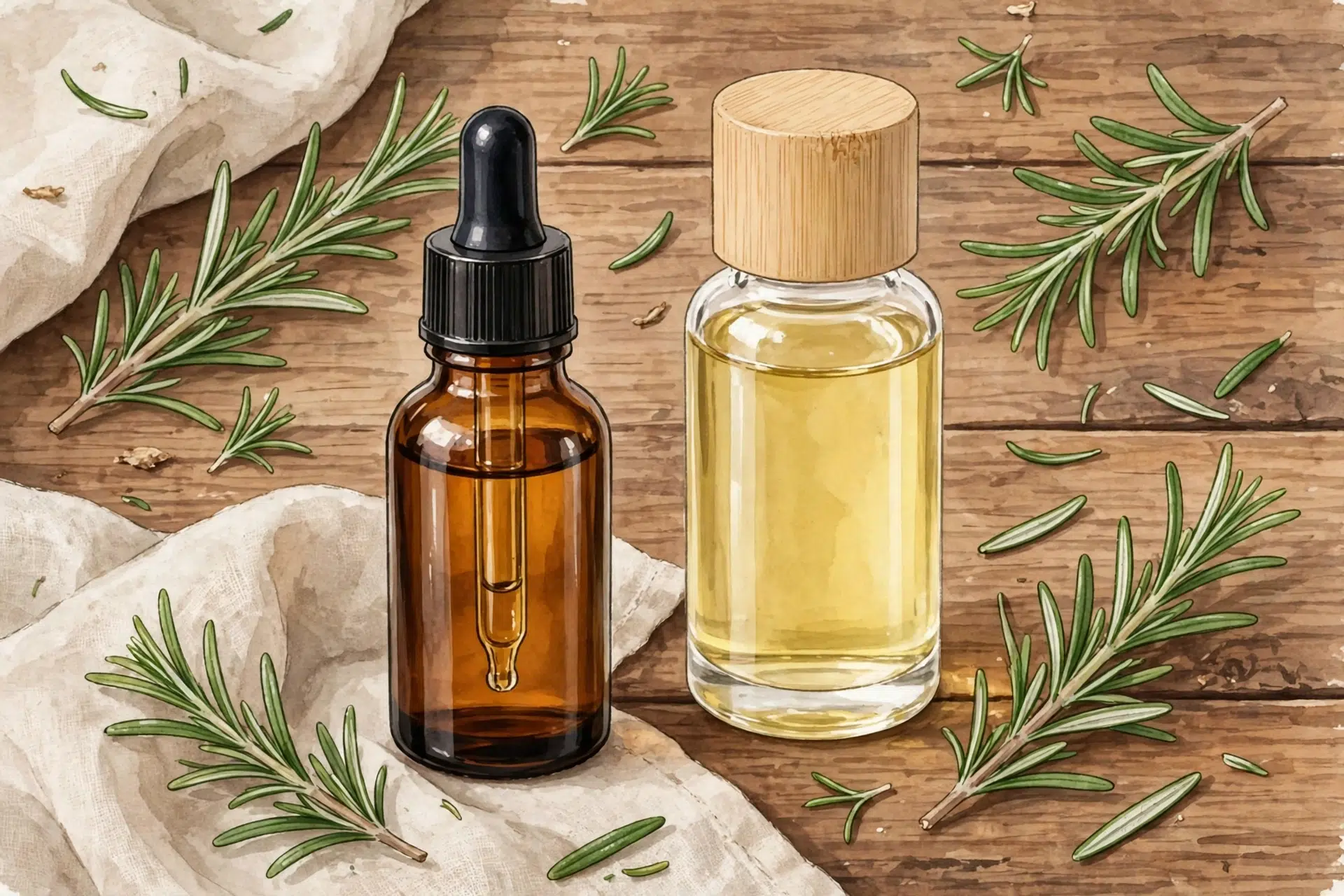
Good carrier oils are jojoba oil, which mimics scalp sebum, coconut oil for dry hair, argan oil for frizz-prone hair, and sweet almond oil for a light feel. Choose one carrier, not a mix of five, so you can tell what your scalp reacts to.
Step-by-Step Routine
- Patch test first. Put a small amount of the diluted oil on your inner forearm or behind your ear and wait 24 hours. If you get redness, burning, or itching, do not use it on your scalp.
- Part your hair in sections and apply the diluted oil directly to the scalp, not just to the hair lengths. About 1 to 2 teaspoons total is usually enough for full scalp coverage.
- Massage gently for 5 to 10 minutes with your fingertips. This helps distribution and is part of the routine in the trial context, not a guarantee of growth on its own.
- Leave it on for at least 30 minutes, or overnight if your scalp tolerates it and you protect your pillow. Wash out with a mild shampoo. Oil build-up left for days can clog follicles and work against you.
- Start once a week to check tolerance, then move to 2 to 3 times a week if there is no irritation. Consistency matters more than using it every day at a strong concentration.

Realistic Timeline: What to Expect, and When
Hair grows slowly, and any honest timeline must say that.
- Weeks 1 to 4: you are only checking tolerance. Do not judge growth yet.
- Months 1 to 3: in the 2015 trial, hair counts improved by three months, but the change was not dramatic at that point for most people. Shedding can still happen for other reasons in this period.
- Month 6: this is the point used in the trial. Judge your result here, with photos in the same light and same hair parting, not by memory.
- After 6 months: if there is no improvement and no irritation, you have a fair test. If there is worsening shedding, a receding pattern that is advancing fast, or bald patches, stop guessing and see a clinician or dermatologist.
Do not expect thicker hair in two weeks. Any product or video promising that is selling a result the evidence does not support.

Rosemary Oil vs Minoxidil: An Honest Comparison
| Factor | Rosemary oil (diluted) | 2% minoxidil |
|---|---|---|
| Best human evidence | One 2015 trial, about 100 people, 6 months | Large body of trials, FDA-approved for pattern hair loss |
| Hair count result in that trial | Significant increase, similar to 2% minoxidil | Significant increase, similar to rosemary oil in that trial |
| Scalp itching | Reported, but less than minoxidil in that trial | More commonly reported |
| How it is used | Diluted in carrier oil, massaged into scalp | Usually 1 ml twice daily, as labelled |
| Cost | Usually low per month | Usually higher per month, varies by brand |
| What it is not | Not a drug, not FDA-approved for hair regrowth | A drug treatment, with its own side effects and shedding phase |
Rosemary oil may be a reasonable, low-cost option to try for mild pattern thinning if you prefer a natural routine and your scalp tolerates it. Minoxidil remains the treatment with far stronger overall evidence. Choosing rosemary oil does not mean you have tried the equivalent of all minoxidil research.
Who Should Avoid Rosemary Oil, or Ask a Clinician First
Skip rosemary oil, or ask a clinician first, if any of these apply:
- You are pregnant or breastfeeding. Essential oil safety in pregnancy is not settled, and a clinician should advise you.
- You have epilepsy or a seizure disorder. Rosemary essential oil is sometimes listed as a caution in aromatherapy guidance for epilepsy.
- You have a sensitive scalp, eczema, psoriasis, or open scalp sores. Oil and massage can worsen irritation.
- You have sudden, patchy, or severe shedding, or shedding with other symptoms such as fatigue, weight change, or irregular periods. Those need a medical cause checked, not an oil.
- You are already using a prescribed hair-loss treatment. Do not stop it to switch to rosemary oil without talking to the prescriber.
- You had an allergic reaction in the patch test.
If you use rosemary oil and get persistent redness, burning, rash, or increased shedding that does not settle, stop using it and seek advice.
Common Mistakes That Make Rosemary Oil Fail
- Using it undiluted. This is the most common mistake, and it causes irritation that forces people to quit.
- Applying it only to hair lengths. Growth, if it happens, is a scalp story, not a hair-tip story.
- Judging it after two weeks, then quitting, then trying a different oil every week. No routine gets a fair test that way.
- Mixing five oils at once. If your scalp reacts, you will not know which ingredient caused it.
- Believing a video that shows dramatic before-and-after photos without a timeline, lighting control, or study link. Photos alone are not evidence.
Frequently Asked Questions About Rosemary Oil for Hair Growth
Does rosemary oil grow hair?
In one 2015 trial, rosemary oil matched 2% minoxidil for hair count after six months in people with pattern hair loss. That is promising, but it is one small trial, not proof that it grows hair for everyone.
How often should I use rosemary oil?
Start once a week, then 2 to 3 times a week if your scalp tolerates it. The trial used twice-daily application, which most people find impractical, and daily strong use increases irritation risk. Consistency at a tolerable frequency is more useful than daily overuse.
How long does rosemary oil take to work?
Judge it at six months, not two weeks. Hair growth is slow, and the trial measured results at three and six months.
Can I leave rosemary oil in my hair overnight?
Yes, if it is diluted and your scalp tolerates it, overnight use is commonly done. Wash it out in the morning with a mild shampoo, and do not leave oil build-up for days.
Is rosemary oil better than minoxidil?
No honest answer says rosemary oil is better overall. In one trial it matched 2% minoxidil for hair count and caused less itching. Minoxidil, especially 5%, has far more research behind it overall.
Does rosemary oil help with dandruff or an itchy scalp?
Rosemary oil has antimicrobial and anti-inflammatory properties studied in general scalp research, and some people find it soothing when diluted. It is not a proven dandruff treatment, and if you have dandruff, flaking, or scalp disease, get that diagnosed first.
Final Verdict
Rosemary oil for hair growth is worth trying, with honest expectations, if you have mild pattern thinning, a healthy scalp, and patience for a six-month test. Use it diluted, patch test first, use it 2 to 3 times a week, and photograph your progress in the same light.
It is not a miracle, not a cure for baldness, and not a replacement for medical advice if your shedding is sudden, severe, or patchy. If it helps your scalp feel healthier and your thinning looks a little denser after six months, that is a good, realistic win. If it does not, you have lost little except time, and you will know you tested it properly.
Related reading on Hair Care: our Peppermint Oil for Hair Growth review explains the same evidence standard — one study, with limits, not a headline — and our Hair Growth Nutrition guide covers the diet and routine side that oil alone cannot fix. You may also like our Mielle Rosemary Mint Oil Review and our Hair Care Routine guide.
Sources and Further Reading
Panahi et al. 2015, SKINmed, rosemary oil vs 2% minoxidil randomized comparative trial; Springer review of controlled trials in hair loss, which summarises the Panahi trial and its limits; American Academy of Dermatology guidance on hair loss, for when to seek a dermatologist. This post is general information, not medical advice. Talk to a clinician about hair loss that is sudden, patchy, or worsening.
Note: This article is general information only and is not medical advice. I am not a doctor. If your hair loss is sudden, patchy, severe, or accompanied by other symptoms, please talk to a clinician or dermatologist.