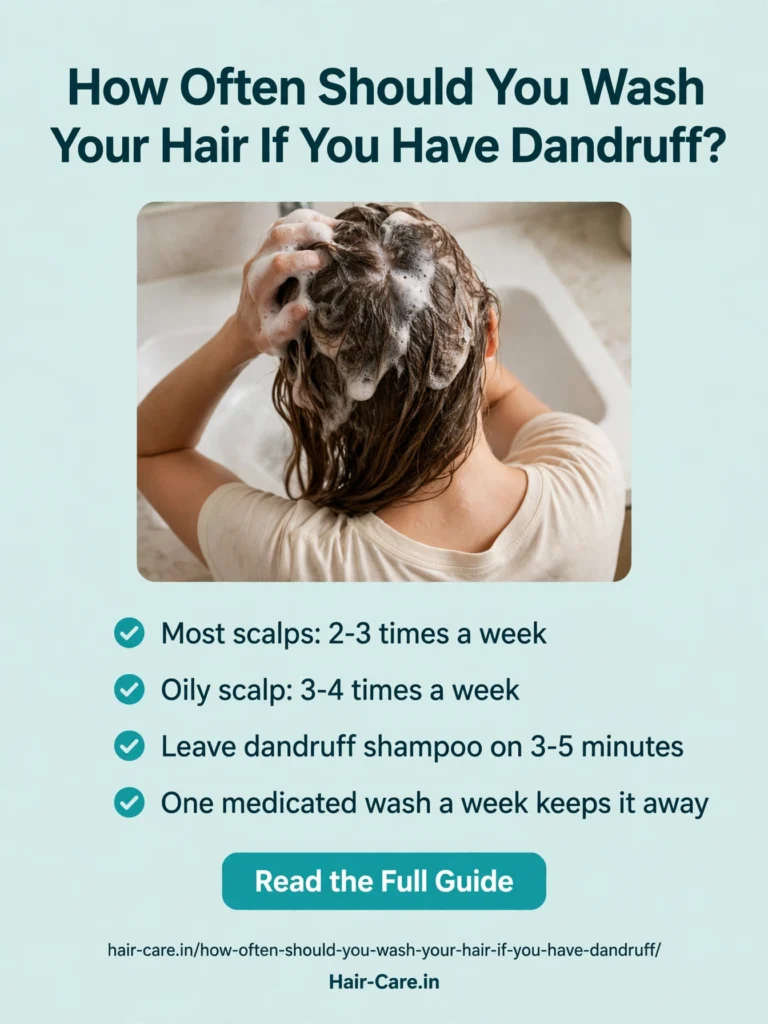
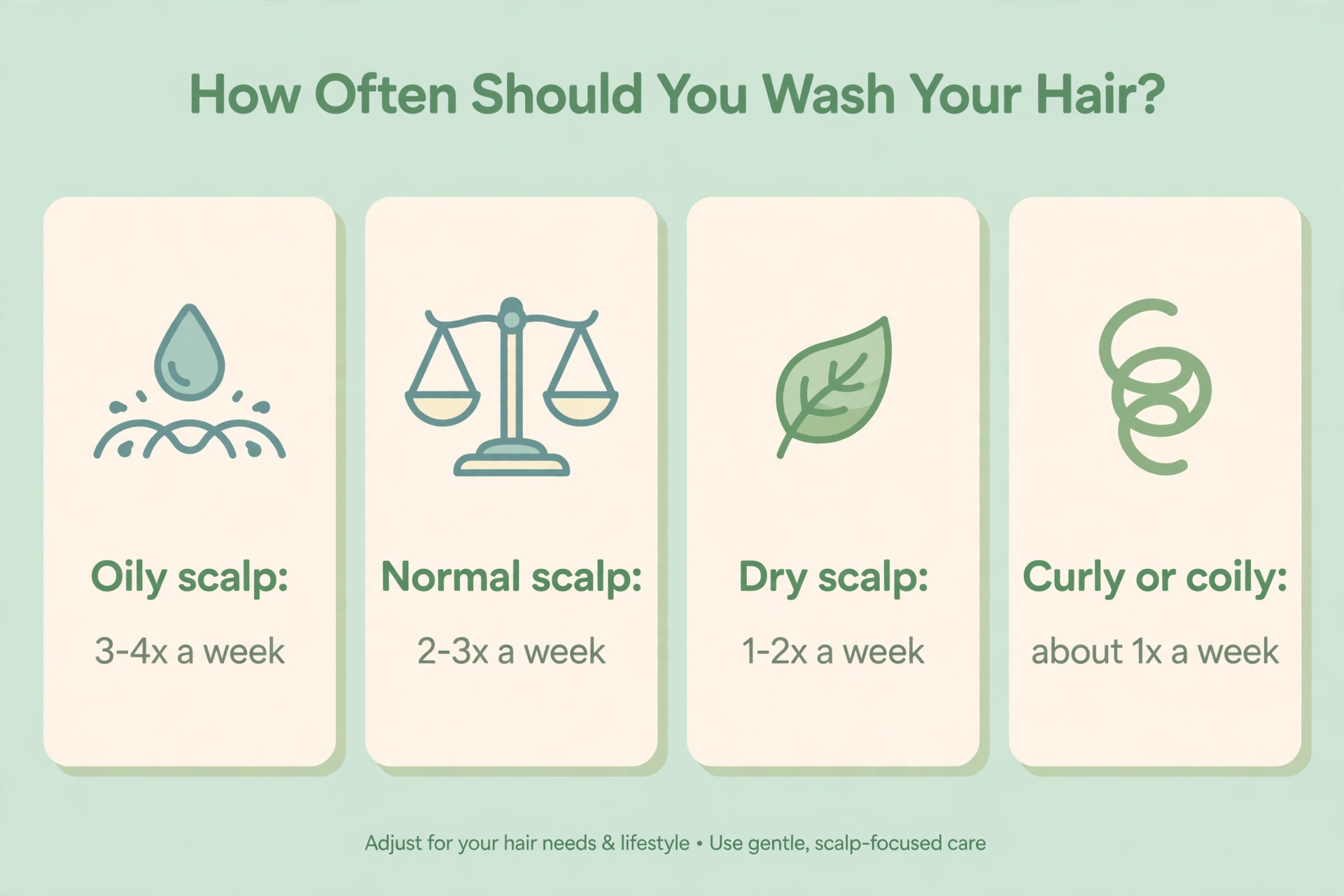
Short answer: Most people with dandruff should wash 2–3 times a week with a dandruff shampoo, and wash more often if the scalp is oily. Oily scalp with dandruff: 3–4 times a week. Normal scalp: 2–3 times a week. Dry scalp with dandruff: 1–2 times a week. Curly or coily hair: about once a week with a dandruff shampoo. The exact number depends on the active ingredient in the shampoo and whether you are in the treatment phase or the maintenance phase — and washing less is not the fix, because dandruff is an oily-scalp condition, not a dry-scalp one.
Why washing frequency matters with dandruff
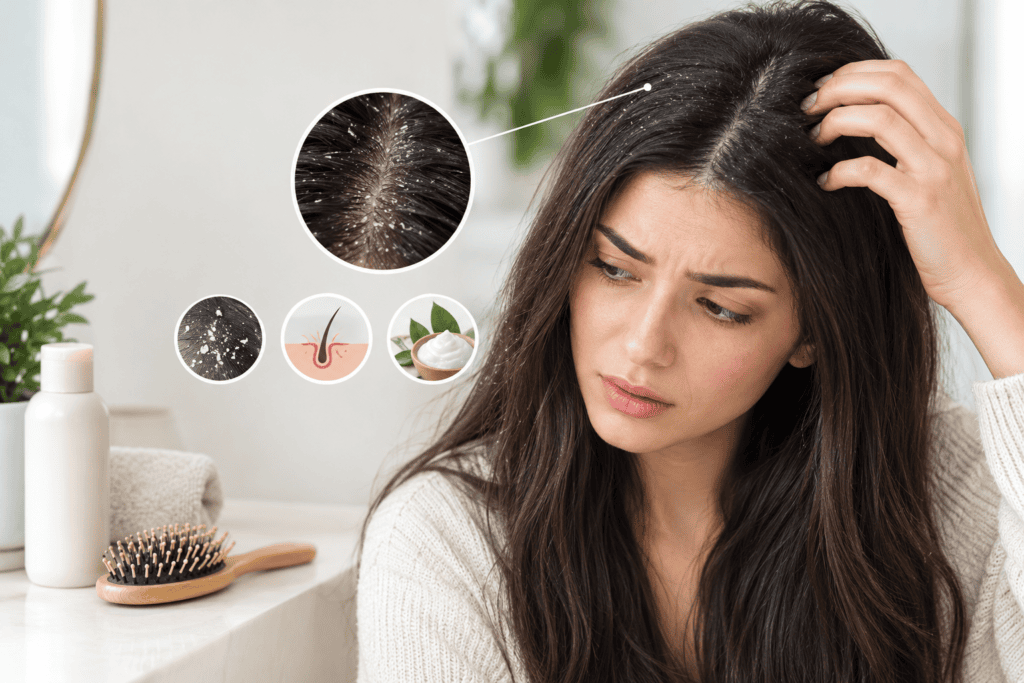
Dandruff is not caused by a dry scalp, and it is not caused by poor hygiene. The American Academy of Dermatology (AAD) states this plainly: dandruff is linked to oily skin, hair-care habits, and some medical conditions. The flakes come from a yeast called Malassezia that lives on everyone’s scalp and feeds on sebum, the scalp’s natural oil. When sebum builds up, the yeast grows, the scalp sheds skin faster, and flakes appear.
That is why washing frequency matters so much. Every wash removes sebum and loose flakes from the scalp. Wash too rarely, and oil and yeast build up — flakes get worse. Wash too harshly, and the scalp barrier gets irritated — itching and flaking get worse in a different way. The right frequency is the middle point: often enough to keep oil down, gently enough to keep the barrier intact.
This is also why the advice “wash less, your scalp will fix itself” is wrong for dandruff. It comes from confusing dandruff with a dry scalp. A dry scalp has tiny, white, powdery flakes and comes from a lack of moisture. Dandruff has larger, yellowish flakes that stick to the scalp and hair, and comes from oil. Washing less helps a dry scalp. Washing less makes dandruff worse. If you are not sure which one you have, the difference matters more than the shampoo: oily, yellowish flakes mean dandruff; dry, powdery flakes mean dry scalp.
How often to wash, by scalp and hair type
There is no single number for everyone, because scalps differ. The schedules below come from the AAD, the Mayo Clinic, and the NHS, and they agree with each other:
| Your scalp and hair | How often to wash | Dandruff shampoo |
|---|---|---|
| Oily scalp + dandruff | 3–4 times a week | 2–3 times a week |
| Normal scalp + dandruff | 2–3 times a week | 2–3 times a week |
| Dry scalp + dandruff | 1–2 times a week | 1–2 times a week |
| Fine or straight hair, oily scalp | Daily or every other day | Twice a week |
| Curly, coily or textured hair | When needed, about once a week | About once a week |
| Seborrheic dermatitis (more severe) | Daily or 2–3 times a week for several weeks | Daily or 2–3 times a week, then less |
The AAD’s rule is simple: if you have fine or naturally straight hair, or an oily scalp, wash often — daily or every other day — and use your dandruff shampoo twice a week. If you have coarse, curly or coily hair, wash when needed and use your dandruff shampoo about once a week, applying it only to the scalp, because the ingredients that treat dandruff can dry the hair lengths.
If you want the general version of this question — how often to wash hair without dandruff — the schedule is different, and it is covered in our guide on how often you should wash your hair.
Treatment phase vs maintenance phase: the part no guide explains
Most guides say “use dandruff shampoo 2–3 times a week” and stop there. That misses the most important distinction: treatment and maintenance are different schedules, and they are different for each active ingredient.
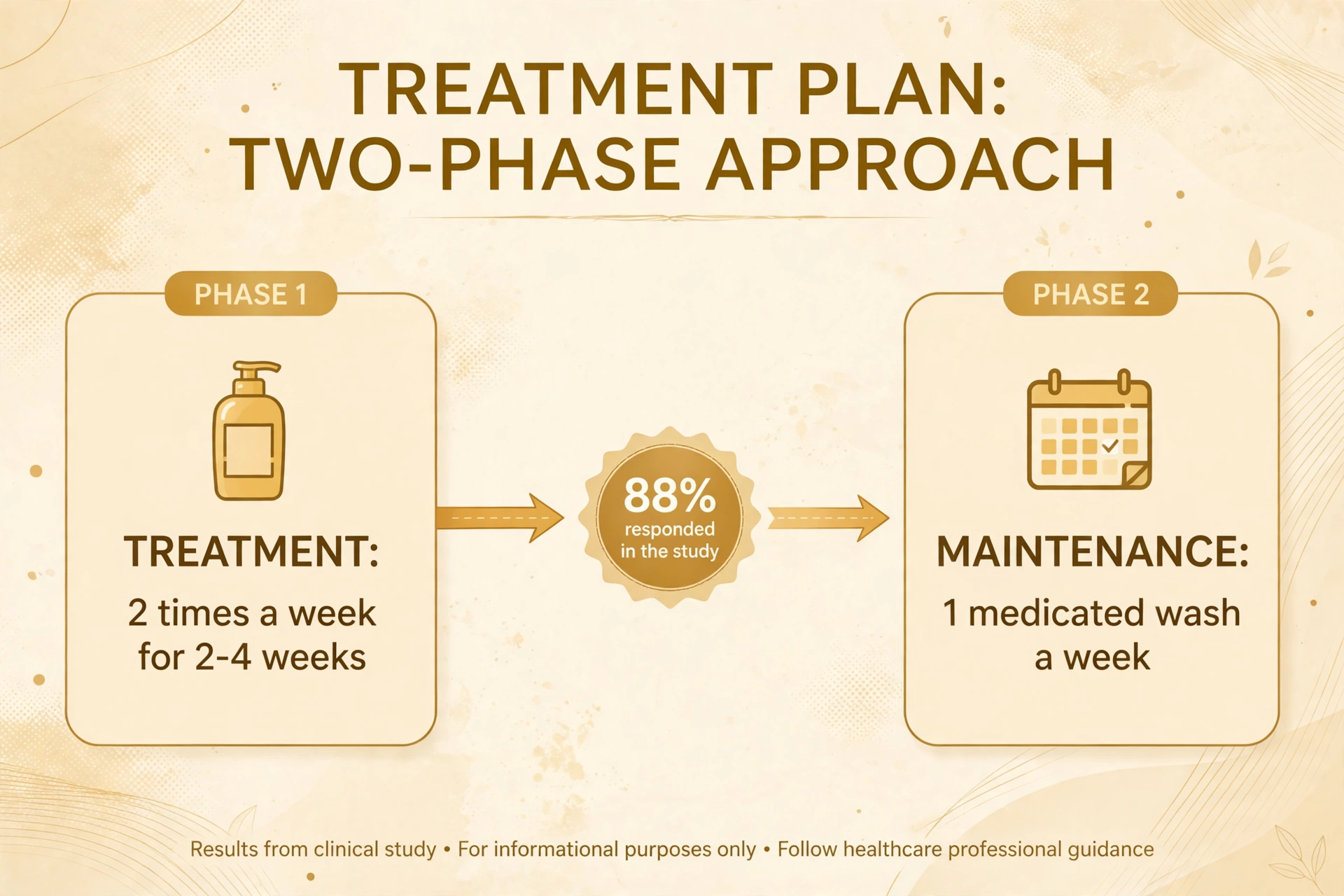
When dandruff is active, you treat it. When it clears, you maintain it — because dandruff comes back if you stop completely. The study that proves this is one no competitor guide uses. In a 1995 trial published in the British Journal of Dermatology, 575 people with moderate-to-severe dandruff or scalp seborrhoeic dermatitis used 2% ketoconazole shampoo twice a week for 2–4 weeks, and 88% had an excellent response. Then 312 of the people who had cleared were followed for 6 months on different maintenance schedules. Relapse was 19% with one medicated wash a week, 47% with a placebo wash, and 31% when the medicated wash was alternated with placebo. One wash a week cut relapse from roughly one in two to roughly one in five. That is the whole maintenance trick, and it is a schedule, not a course: one medicated wash a week, indefinitely, with normal shampoo on the other wash days.
Here is the schedule per active ingredient:
| Active ingredient | Treatment phase | Maintenance phase | Notes |
|---|---|---|---|
| Ketoconazole 2% | Twice a week for 2–4 weeks | Once a week, or once every 1–2 weeks | Leave on 3–5 minutes. Prescription strength in many countries; 1% is sold over the counter |
| Ketoconazole 1% (OTC) | Every 3–4 days, up to 8 weeks | Only as needed | Follow the label; the schedule above is for the 2% version |
| Zinc pyrithione | 2–3 times a week | 2–3 times a week, or daily if tolerated | Gentle enough for daily use for most people |
| Selenium sulfide | 2–3 times a week | Once a week | Can dry the hair; follow with conditioner on the lengths |
| Salicylic acid | 2–3 times a week | 1–2 times a week | Helps lift scale; often combined with another active |
| Coal tar | 2–3 times a week | Once a week | Strong smell; can stain light hair and bedding |
The exact schedule also depends on the product label — always read it, because leave-on time and frequency differ by product. The AAD lists all six of these actives — zinc pyrithione, salicylic acid, sulfur, selenium sulfide, ketoconazole and coal tar — and advises rotating between shampoos with different actives if one stops working.
For the full ketoconazole schedule, including how to use it step by step, see our guide on how to use ketoconazole shampoo for dandruff.
Dandruff vs seborrheic dermatitis: the schedules are different
Dandruff and seborrhoeic dermatitis are the same condition at different severity levels — mild flaking is called dandruff, and when there is also redness, greasy yellow scaling and itching, it is called seborrhoeic dermatitis. The wash schedules are different, and no competitor guide contrasts them clearly.
The Mayo Clinic’s guidance is: for dandruff, wash more often with a gentle shampoo first, and use a medicated shampoo 2–3 times a week. For seborrhoeic dermatitis, use a medicated shampoo once a day or 2–3 times a week for several weeks, and after the symptoms clear, use it once a week or once every two weeks to prevent relapse. If your flakes come with red, inflamed skin, greasy yellow scales, or patches beyond the scalp — on the face, ears or chest — that points toward seborrhoeic dermatitis, and the schedule above applies. If that does not improve, see a clinician rather than washing harder.
How to wash: the technique that makes the schedule work
Frequency alone does not work if the technique is wrong. Most people rinse dandruff shampoo out immediately, which gives the active ingredient almost no time on the skin where the yeast lives. The correct technique, from the AAD and the NHS, is:
- Wet the hair and scalp with lukewarm water — not very hot water, which strips the scalp barrier.
- Apply the dandruff shampoo to the scalp, not the hair lengths. Massage it in with your fingertips, not your nails, to lift scale from the scalp.
- Leave it on the scalp for 3–5 minutes (some products say 5–10 minutes — follow your bottle). This is the step most people skip, and it is the step that makes the active ingredient work.
- Rinse thoroughly until no residue remains. Residue left on the scalp causes buildup and itching.
- If your hair needs it, wash again with your normal shampoo, and use conditioner only on the mid-lengths and ends — not on the scalp.
If your scalp is sensitive as well as flaky, the gentle washing method matters even more. Our guide on how to wash hair without drying your scalp covers the fingertip technique, lukewarm water, and what to avoid.

Can you use dandruff shampoo every day?
It depends on the active ingredient. Zinc pyrithione is gentle enough for daily use for most people — it is the active in many everyday dandruff shampoos. Ketoconazole 2% should not be used daily: twice a week for 2–4 weeks, then once a week or once every 1–2 weeks for maintenance. Selenium sulfide and coal tar are also not daily products for most people. The pattern is simple: gentle actives can be used often; strong antifungal actives work on a schedule, and more is not better.
If one dandruff shampoo stops working after a while, the AAD’s advice is to rotate to a shampoo with a different active ingredient rather than washing more often with the same one. And if you use a medicated shampoo, you can still use your normal shampoo and conditioner on the other wash days — the medicated wash is one wash a week in maintenance, not every wash.
When washing more makes it worse
Washing more helps dandruff — but only if each wash is gentle. Washing more with a harsh shampoo, very hot water, or scratching with nails makes things worse, because the scalp barrier is already irritated. The signs that washing is doing harm rather than good: the scalp feels tight and dry after washing, itching increases right after a wash, or flakes get smaller and powdery instead of oily and yellow. That pattern points to a dry or irritated scalp, not dandruff getting worse — and the fix is gentler washing, not more washing.
Hard water makes this worse. In many Gulf and Saudi cities the water is very hard — 200–600 mg/L of calcium and magnesium — and those minerals leave a coating on the hair and scalp that makes shampoo less effective and hair rougher. If your water is very hard, the wash schedule above still applies, but the water itself works against you. Our guide on how to wash hair in hard water covers the chelating-shampoo step and how to test your own water.
Dry shampoo and styling products are the other buildup angle. Dry shampoo absorbs oil, which feels like a fix, but it leaves residue on the scalp that traps oil and yeast underneath. If you use dry shampoo, count it as a styling product, not a wash — and wash properly on the next wash day instead of stretching the gap further. The same applies to heavy oils and pomades left on the scalp: the AAD advises using pomade sparingly, because it can lead to flare-ups.
When to see a doctor
Wash on the schedule above for up to 4 weeks and judge the result. The NHS says to use an anti-dandruff shampoo for up to 4 weeks to see if it gets better, and to see a GP if symptoms are still there after a month. See a clinician sooner if the scalp is red or swollen, if there are flaky, itchy patches on the face or body, if the itching is severe, if there is hair loss, or if the scalp is painful or oozing. Dandruff is common and usually manageable at home, but those signs point to something that needs a diagnosis, not a different shampoo. This post is research, not a diagnosis — a clinician who can see your scalp is the right next step when home treatment does not work.
Frequently asked questions
Should I wash my hair every day if I have dandruff?
If your scalp is oily, yes — daily washing with a gentle shampoo is fine, and the AAD says people with fine or straight hair or an oily scalp may need to shampoo daily or every other day. Use the dandruff shampoo itself 2–3 times a week, not every wash, unless its active ingredient is gentle enough for daily use (zinc pyrithione usually is; ketoconazole 2% is not).
Does washing hair daily make dandruff worse?
No — for dandruff, washing more usually helps, because it removes the sebum the yeast feeds on. A dermatologist quoted by the Merck Manual puts it plainly: increase the frequency, whatever the frequency may be. What makes dandruff worse is washing rarely, so oil accumulates. Daily washing only becomes a problem if the shampoo is harsh, the water is very hot, or the scalp is actually dry rather than dandruff-prone.
Does washing your hair too often cause dandruff?
Washing too often does not cause dandruff. Dandruff is caused by the yeast Malassezia feeding on scalp oil, not by washing. Over-washing with harsh products can irritate the scalp and cause dryness and flaking that looks similar, but that is irritation, not dandruff.
Can I use ketoconazole shampoo daily?
No — not the 2% version. Use it twice a week for 2–4 weeks, then once a week or once every 1–2 weeks for maintenance, leaving it on the scalp for 3–5 minutes. The 1% over-the-counter version is used every 3–4 days for up to 8 weeks, then only as needed. Daily use does not clear dandruff faster and can dry the scalp.
Should I wash my hair more or less if I have dandruff?
More, not less — gently. Letting oil sit feeds the yeast. Wash 2–3 times a week as a starting point, 3–4 times if the scalp is oily, and use a dandruff shampoo on the schedule for its active ingredient. If the scalp feels tight and dry after washing, the wash is too harsh, not too frequent — switch to a gentler shampoo and lukewarm water.
My scalp is oily and flaky — should I wash more or less often?
More often. Oily and flaky together is the classic dandruff pattern, and oil is the fuel. Wash 3–4 times a week, use a dandruff shampoo 2–3 times a week, leave it on for 3–5 minutes, and rinse fully. If there is no improvement after 4 weeks, see a clinician.
Watch: How to treat dandruff (American Academy of Dermatology)
Watch on YouTube: Video by the American Academy of Dermatology — “How to Treat Dandruff”
https://www.youtube.com/watch?v=wcYUod1AthY
This is the AAD’s own video, not ours. It shows the same tips this post is based on: choosing a dandruff shampoo by active ingredient, applying it to the scalp, and giving it time to work before rinsing. If the video does not play here, use the link above to watch it on YouTube.
The bottom line
How often you wash your hair with dandruff is not one number — it is a schedule. Start with 2–3 washes a week, 3–4 if the scalp is oily, about once a week if the hair is curly or coily. Use the dandruff shampoo on its own schedule: treat for 2–4 weeks, then maintain with one medicated wash a week. Leave the shampoo on the scalp for 3–5 minutes, use lukewarm water, rinse fully, and judge the result after 4 weeks. And remember the study behind the maintenance schedule: one medicated wash a week cut 6-month relapse from 47% to 19%. Dandruff is not a one-time fix — it is a habit, and the habit is one wash a week.
The next post in this cluster answers the question this schedule raises: why does dandruff keep coming back, and what maintenance schedule stops the relapse.
Sources
- American Academy of Dermatology — How to treat dandruff
- Mayo Clinic — Dandruff: Diagnosis and treatment
- Mayo Clinic — Seborrheic dermatitis: Diagnosis and treatment
- NHS — Dandruff
- Peter & Richarz-Barthauer (1995), British Journal of Dermatology 132:441–445 — 2% ketoconazole shampoo trial, 575 patients