Short answer
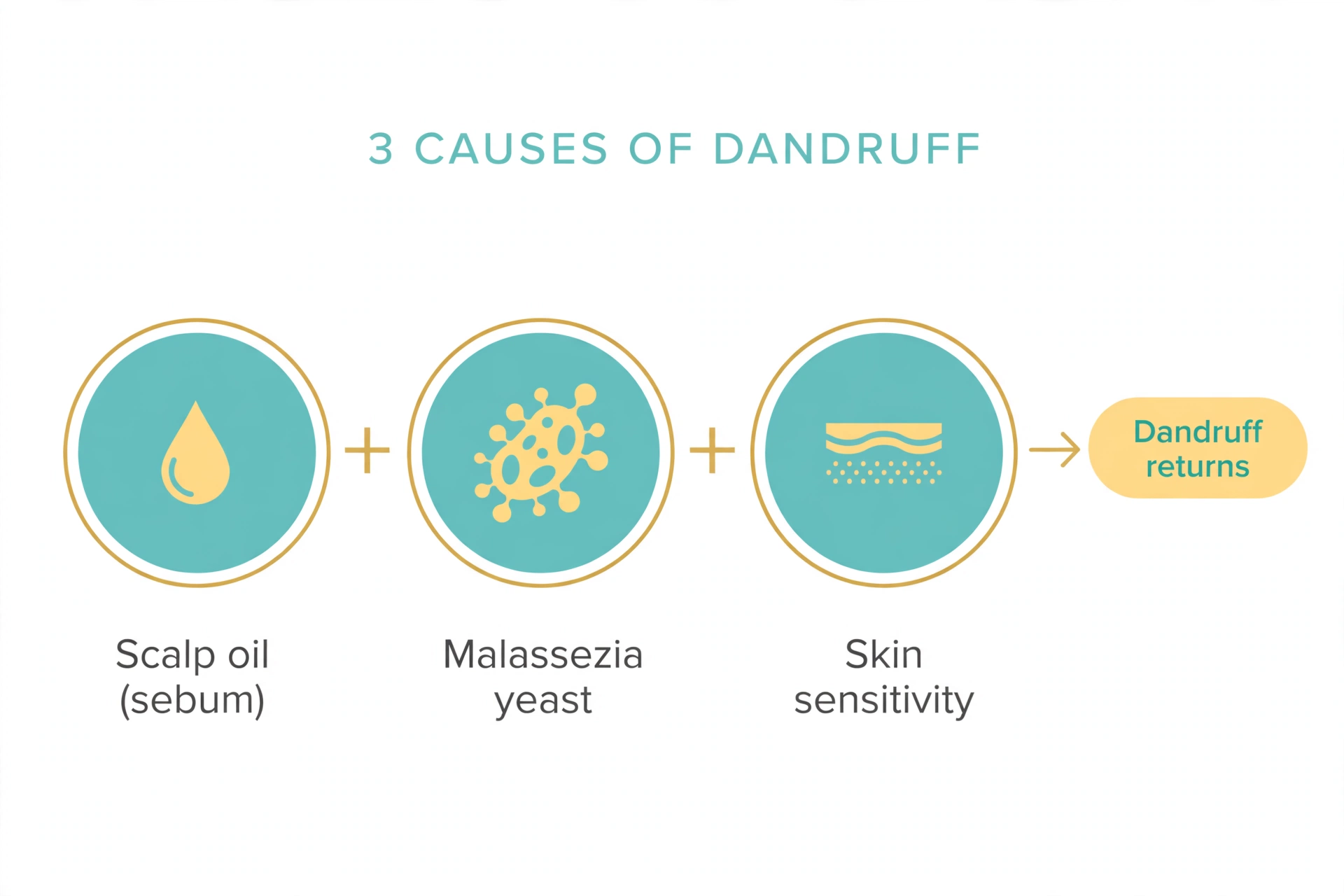
Dandruff keeps coming back because the three things that cause it — scalp oil, a yeast called Malassezia, and your skin’s sensitivity to that yeast — never leave your scalp. A dandruff shampoo suppresses the cycle; it does not end it. When you stop using it, the cycle restarts, and flakes commonly return within weeks.
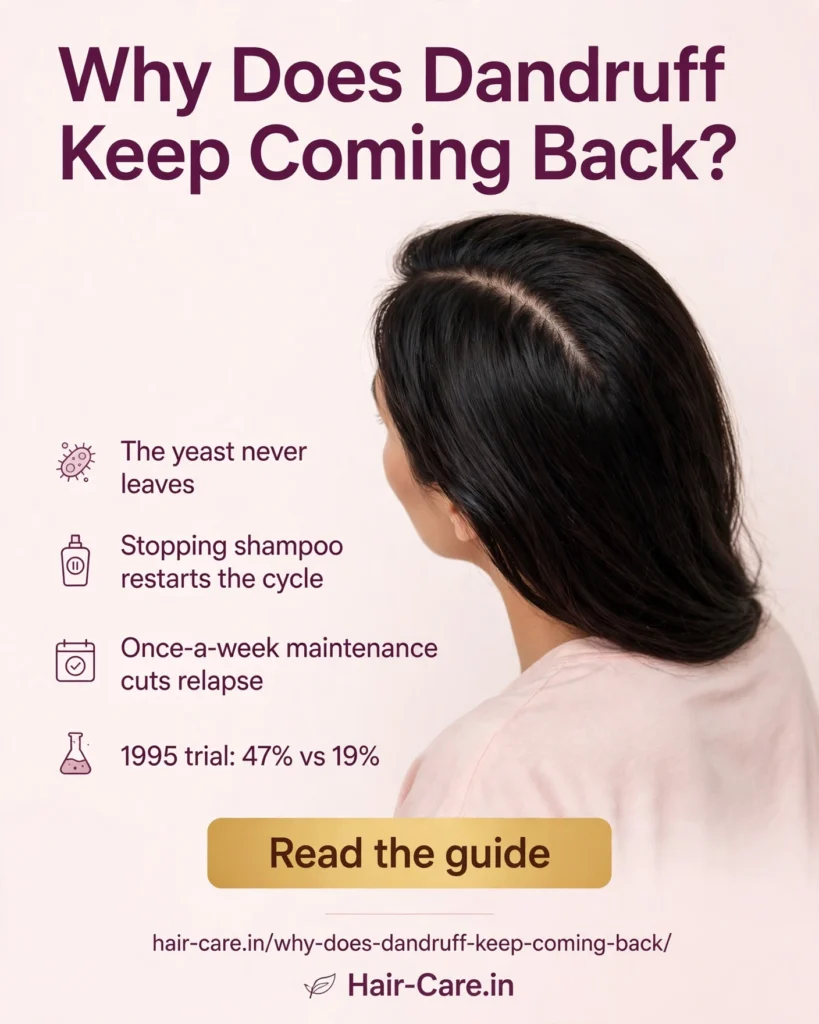
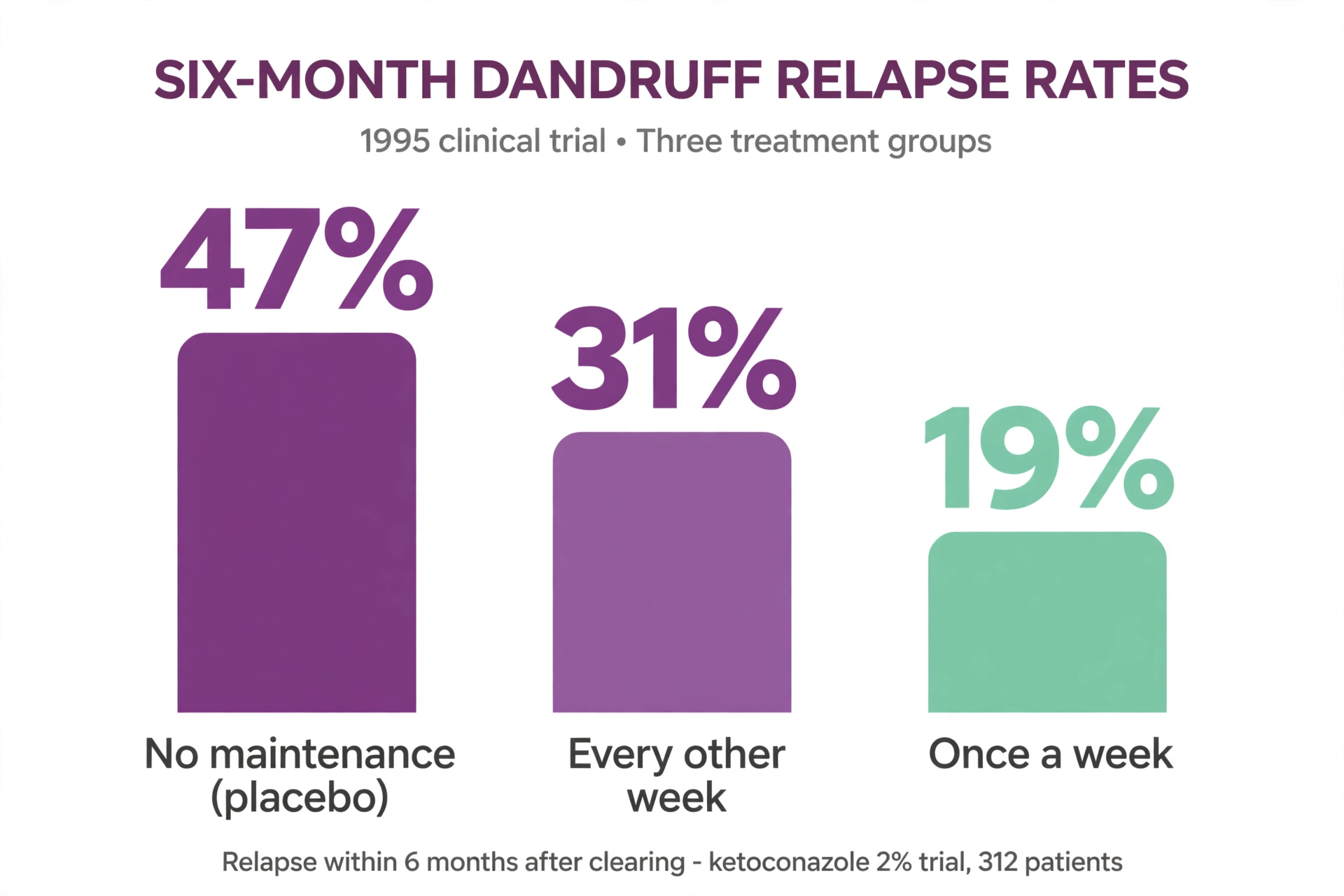
The fix is not a stronger shampoo. It is a maintenance schedule: clear the flakes first with a medicated shampoo two to three times a week for two to four weeks, then keep using it once a week, indefinitely. In the largest relapse trial ever run, that once-a-week schedule cut six-month relapse from 47% (on placebo) to 19%.
There is no cure for dandruff — the Mayo Clinic says so plainly — but with a maintenance schedule, most people can keep it under control.
Why it comes back: the three factors
Dandruff is a mild form of seborrheic dermatitis, and it comes from three factors working together:
- Sebum (scalp oil). Malassezia yeast feeds on the oil your scalp naturally produces. More oil means more food for the yeast.
- Malassezia yeast. This yeast lives on everyone’s skin. In dandruff, the yeast population grows and the skin reacts to it.
- Your skin’s sensitivity. Not everyone with oily skin and yeast gets dandruff. Your skin’s immune response to the yeast is the third factor — and it is the one you cannot change.
A medicated shampoo attacks the yeast and slows the flaking. But it does not remove the oil production, it does not sterilise the scalp, and it does not change your skin’s sensitivity. So when the shampoo stops, the yeast population recovers, the skin reacts again, and the flakes return. That is why dandruff is a condition to manage, not an infection to finish off.
Two things that do NOT cause dandruff, despite what many people believe: poor hygiene, and a dry scalp. The American Academy of Dermatology (AAD) states that dandruff is not caused by poor hygiene, and the NHS notes the same. Dandruff is linked to oily skin and yeast, not to dryness.
The trial that measured relapse
Most dandruff advice is guesswork about how long results last. One trial actually measured it.
In 1995, Peter and Richarz-Barthauer ran a multicentre, double-blind, placebo-controlled trial of 2% ketoconazole shampoo (British Journal of Dermatology; PubMed 7718463). The numbers:
- 575 patients with moderate-to-severe scalp seborrheic dermatitis or dandruff used ketoconazole 2% shampoo twice a week for two to four weeks. 88% had an excellent response — the flakes cleared.
- 312 of those responders then entered a six-month prevention phase, split into three groups: ketoconazole 2% once a week, ketoconazole alternating with placebo every other week, or placebo once a week.
- Six-month relapse: 47% on placebo, 31% on the alternating schedule, and 19% on once-weekly ketoconazole.
Read that again: even doing nothing after clearing, about half the people relapsed within six months. Once-weekly ketoconazole cut that to fewer than one in five. And the alternating schedule — active shampoo every other week — sat in between at 31%. The schedule itself is the treatment.
The medication was well tolerated in all three groups, and the authors concluded that ketoconazole 2% shampoo is “highly effective, not only in clearing scalp seborrhoeic dermatitis and dandruff, but also in preventing relapse of the disease when used prophylactically once weekly.”
A later trial compared ketoconazole 2% against zinc pyrithione 1% (Piérard-Franchimont et al., 2002; PubMed 12476017). Of 343 people recruited, 331 were eligible — 171 used ketoconazole 2% and 160 used zinc pyrithione 1%, twice a week for four weeks, then four weeks with no treatment. At week four, ketoconazole improved total dandruff severity by 73%, zinc pyrithione by 67% — a statistically significant difference — and the recurrence rate after treatment was also significantly lower with ketoconazole.
A Cochrane review of 51 studies with 9,052 participants (Okokon et al., 2015; CD008138) found ketoconazole 2% gave a 31% lower risk of failed clearance than placebo at four weeks — though the evidence was rated low quality — and 44% fewer side effects than steroid treatments. The review also noted that very few studies looked at symptom clearance for longer than four weeks, which is exactly why the 1995 six-month trial matters so much.
Treatment vs maintenance: the per-active table
Every active ingredient works on a different part of the problem, and each one has a clearing phase and a maintenance phase. No major guide publishes this table — most give one generic schedule for all shampoos. Here it is, built from the AAD guidance, the trial data, and the NHS advice:
| Active ingredient | Clearing phase (flare) | Maintenance phase (once clear) | What it does |
|---|---|---|---|
| Ketoconazole 2% | 2× a week, 2–4 weeks | 1× a week, ongoing | Antifungal — reduces Malassezia; the only active with six-month relapse trial data |
| Zinc pyrithione 1–2% | 2–3× a week, 2–4 weeks | 1× a week, ongoing | Antifungal + antibacterial; the most common OTC active |
| Selenium sulfide 1–2.5% | 2× a week, 2–4 weeks | 1× a week or every 2 weeks | Antifungal; slows skin-cell turnover |
| Salicylic acid 3% | 2–3× a week, 2–4 weeks | 1× a week, ongoing | Lifts and loosens scale so other actives can reach the scalp |
| Coal tar | 2× a week, 2–4 weeks | 1× a week, ongoing | Slows skin-cell turnover; increases sun sensitivity — protect the scalp from sun |
| Ciclopirox 1% | 2× a week, 4 weeks | 1× a week, ongoing | Antifungal; the Cochrane review found it similar to ketoconazole in effect |
Two notes on this table. First, the 2% ketoconazole numbers come from the prescription-strength formulation. Many over-the-counter ketoconazole shampoos are 1%, and a 2001 trial of 66 patients found the 2% shampoo significantly better than the 1% at both two and four weeks for reducing flakiness and yeast density. If you are using a 1% product and it is not holding the flakes off, that strength difference is worth knowing about — and worth discussing with a pharmacist or clinician.
Second, the “leave it on” time matters. The AAD advises applying the shampoo to the scalp and leaving some dandruff shampoos on for about five to ten minutes before rinsing, depending on the label. No trial has established the single best contact time — be honest about that — but rinsing immediately after applying is the most common technique mistake.
The four-week plan and the maintenance calendar
Here is the schedule, step by step:
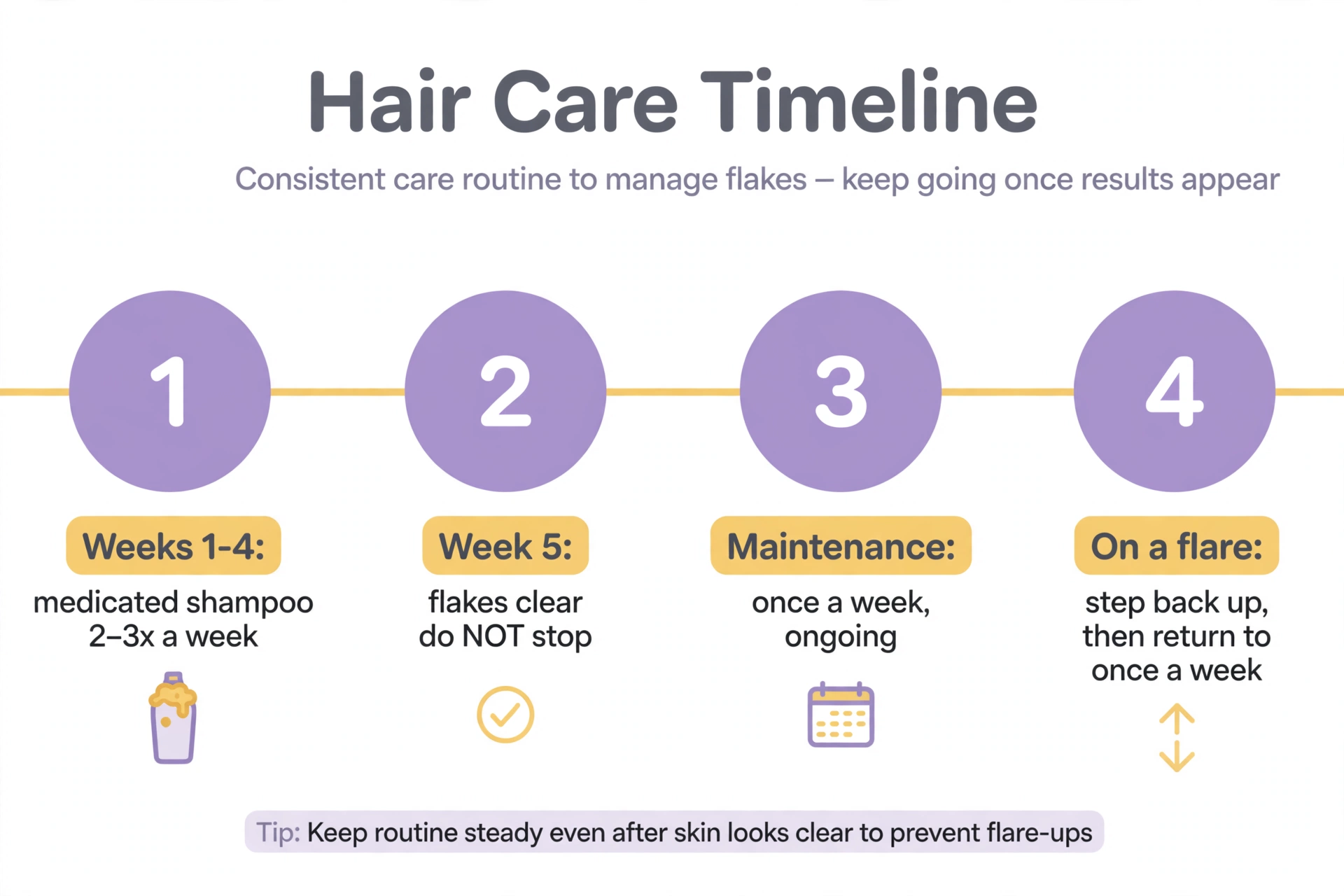
Weeks 1–4: clearing. Use your medicated shampoo two to three times a week (twice a week is the trialled ketoconazole rhythm). Leave it on the scalp for three to five minutes — up to ten if the label says so. On the other wash days, use a gentle regular shampoo. The NHS advises giving a shampoo up to four weeks before judging whether it works. For the full step-by-step method, see our guide: How to Use Ketoconazole Shampoo for Dandruff
Week 5 onward: maintenance. Once the flakes are gone, do NOT stop. Drop to once a week with the same medicated shampoo, and keep that going indefinitely. This is the step the 1995 trial tested — and the step most people skip.
On a flare: step back up to two to three times a week until the flakes settle, then return to once a week. A flare is not a failure of the shampoo. It is the schedule doing its job.
The one rule that matters most: do not stop when you look clear. Looking clear is the maintenance phase working, not a sign that the condition is gone. The people who relapsed in the trial were the ones whose schedule stopped.
Schedules by hair type
The AAD gives different frequencies by hair type, and this is where many guides go wrong by giving one schedule to everyone:
- Straight, fine, or oily hair: wash often — daily or every other day — and use the dandruff shampoo twice a week during clearing, then once a week for maintenance.
- Curly or coily hair: wash when needed, and use the dandruff shampoo about once a week. Apply it only to the scalp — the active ingredients can dry out the hair lengths. This matters because a once-a-week wash is the normal routine for coily hair, so the maintenance schedule fits naturally into it.
- Chemically treated or colour-treated hair: medicated shampoos can be drying. Use conditioner on the lengths (not the scalp), and if dryness is a problem, ask a pharmacist or clinician about a gentler active such as zinc pyrithione.
If you have coily hair and have been told to wash more often for dandruff, that advice conflicts with how coily hair is normally cared for. The AAD’s once-a-week scalp-only approach is the schedule built for your hair type.
“It worked, then stopped working” — the tolerance feeling
This is the complaint that appears in every forum thread about dandruff: the shampoo worked for months, then the flakes came back, so the scalp must have “got used to it.”
There are three more likely explanations, and none of them is true tolerance:
- The schedule slipped. Maintenance once a week quietly became once a fortnight, then “when I remember.” The yeast population recovers gradually, so the return feels sudden when it crosses the visible threshold.
- A trigger changed. Stress, cold dry weather, illness, a new styling product, or a season change can push the cycle back into a flare. The Mayo Clinic notes dandruff may get worse when you are stressed or during cold, dry weather.
- The yeast is hiding deeper than the shampoo reaches. Researchers at the University of South Australia have pointed out that zinc pyrithione reaches the skin surface but less reliably reaches deep into hair follicles — so yeast sheltering in follicles may explain recurrence. This is an active research question, not a settled fact, but it explains why a shampoo that “worked” can seem to stop working.
What actually helps when a shampoo seems to stop working is rotation: the AAD advises that if one dandruff shampoo does not work, try alternating between dandruff shampoos with different active ingredients. Rotate the active — for example ketoconazole one week, zinc pyrithione or selenium sulfide the next — rather than buying a stronger version of the same thing.
When washing more makes it worse
Most dandruff advice says “wash more.” That is only half true.
Gentle, frequent washing helps: it removes oil and loose scale, and it gets the active ingredient onto the scalp regularly. But harsh, daily washing with a medicated shampoo, very hot water, and vigorous scratching can irritate a scalp whose barrier is already damaged — and an irritated scalp flakes more. The Nizoral label itself directs use every three to four days, not daily, and daily use of a medicated shampoo when it is not directed can irritate the scalp.
The distinction is simple: wash often if you wash gently, with lukewarm water, fingertips (not nails), and a shampoo your scalp tolerates. Wash less aggressively if your scalp is red, sore, or itchy after washing — and step the medicated shampoo back to the maintenance frequency rather than using it every day. If your scalp is easily irritated, the gentle wash-day steps are covered in detail in our Sensitive Scalp Care Routine
Dry shampoo and styling buildup
Dry shampoo does not treat dandruff. It absorbs oil at the roots and makes hair look fresher between washes — but the powder, along with heavy styling products, pomades and oils, adds a layer of congestion on the scalp. That layer traps oil and scale against the skin and can make a flare worse.
If you use dry shampoo regularly, two rules: use it on the hair, not piled onto the scalp, and wash it out properly on your next wash day rather than layering it for days. On a medicated wash day, apply the dandruff shampoo to a clean, wet scalp so the active ingredient actually reaches the skin.
Hard water and your scalp
Readers in Saudi Arabia and the Gulf often ask whether hard water is making their dandruff worse. The honest answer has two parts.
First, hard water does not cause dandruff. No source claims that, and the mineral-deposit study often cited in this debate looked at the hair shaft, not the scalp — and found no significant difference in calcium on the hair. Do not blame hard water for dandruff.
Second, very hard water is a real local context. Many Gulf cities have water hardness of 200–600 mg/L, far above soft-water cities. Hard water leaves mineral residue on hair, makes shampoo harder to rinse out, and can leave the scalp feeling coated — which is uncomfortable and can make you wash more aggressively. If your water is very hard, a chelating shampoo once a week (on a non-medicated wash day) and thorough rinsing can help the residue problem. It will not cure dandruff, but it removes one local irritant. Read our full guide: How to Wash Hair in Hard Water
A seasonal plan
Dandruff search interest peaks in winter, and cold, dry weather is a known flare trigger. A seasonal plan is simple: start (or restart) your maintenance schedule before winter rather than after the flare arrives. Keep the once-a-week maintenance going through the cold months, and step up to twice a week at the first sign of a flare instead of waiting for heavy flaking. In summer, the same once-a-week maintenance usually holds — heat and humidity are triggers for some people, but the schedule does not change, only your attention to it does.
Dandruff vs seborrheic dermatitis: different schedules?
Dandruff is the mildest form of seborrheic dermatitis — the same condition, milder. The schedules differ mainly in how long and how firmly you hold them:
| Dandruff | Seborrheic dermatitis | |
|---|---|---|
| Clearing | Medicated shampoo 2–3× a week, 2–4 weeks | Medicated shampoo 2–3× a week, 2–4 weeks, sometimes with a prescribed product |
| Maintenance | 1× a week, ongoing | 1× a week, ongoing — often long term, and flare-ups are expected |
| When to get help | No improvement after 4 weeks of shampoo | Red, swollen or very itchy scalp; patches on the face or body; hair loss in patches |
| Key point | OTC maintenance is often enough | A clinician may need to be involved for stronger treatment |
If your flakes come with red, swollen skin, thick yellowish scale, patches beyond the scalp, or hair loss, that is beyond plain dandruff — see a clinician rather than switching shampoos again.
When it is not dandruff
Not every flaky scalp is dandruff. The NHS lists the common lookalikes: seborrheic dermatitis (scaly, itchy red patches), tinea capitis or ringworm of the scalp (red or silvery rash, patchy hair loss), eczema, contact dermatitis from a hair product, and psoriasis (silvery scales). A dry scalp also flakes — but dry-scalp flakes are small, dry and white, and come with dry skin elsewhere, while dandruff flakes are larger, oily and yellowish.
The four-week rule applies here too: if you have used an anti-dandruff shampoo properly for four weeks and there is no improvement, or if the scalp is bad, very itchy, red or swollen, or there are flaky itchy patches on your face or body, see a GP or dermatologist. A wrong diagnosis is one of the most common reasons a “dandruff” problem never gets better.
Frequently Asked Questions
Why does my dandruff keep coming back?
Because the yeast, the oil and your skin’s sensitivity never leave. Treatment suppresses the cycle; it does not end it. In the 1995 trial, 47% of people relapsed within six months after stopping, against 19% who kept a once-a-week maintenance schedule.
How long should I leave dandruff shampoo on?
Three to five minutes on the scalp is the usual guidance, and the AAD notes some shampoos need five to ten minutes — follow the label. Rinsing immediately after applying is the most common technique mistake.
Should I switch between different anti-dandruff shampoos?
Yes, if one stops working. The AAD advises alternating between shampoos with different active ingredients — for example ketoconazole one week and zinc pyrithione or selenium sulfide the next.
How often should I use dandruff shampoo?
Twice a week while clearing flakes (two to four weeks), then once a week for maintenance, indefinitely. Read the full wash-frequency guide: How Often Should You Wash Your Hair If You Have Dandruff?
What happens if dandruff comes back after I stop?
It usually does — flakes commonly return within weeks. That is the condition’s normal pattern, not a failure. Restart the clearing schedule (two to three times a week) until the flakes settle, then return to once-a-week maintenance.
Can dandruff cause hair loss?
Dandruff itself is not a known cause of hair loss. Heavy scratching can break hair and irritate the scalp, and some scalp conditions that look like dandruff can affect hair. If you are losing hair in patches, see a clinician rather than changing shampoo.
When should I see a doctor about dandruff?
If there is no improvement after four weeks of proper shampoo use, or if the scalp is red, swollen or very itchy, or there are flaky patches on your face or body — the NHS advises seeing a GP in those cases.
Watch: how dermatologists explain dandruff treatment
Watch on YouTube: Video by Dr Dray — “Dermatologist Explains How To Treat Seborrheic Dermatitis” — https://www.youtube.com/watch?v=XiczXHrebEc
The bottom line
Dandruff comes back because the cause never leaves — only the symptoms do. The 1995 trial put a number on it: stop the schedule and nearly half of people relapse within six months; keep a once-a-week maintenance schedule and that falls to fewer than one in five.
So the plan is simple, and it is the same plan the evidence supports: clear with a medicated shampoo two to three times a week for two to four weeks, then maintain once a week, indefinitely. Step up on a flare, step down when calm, rotate the active if one stops working, and see a clinician if four weeks of proper use brings no improvement.
You do not need a stronger shampoo. You need a schedule you keep.