Short answer
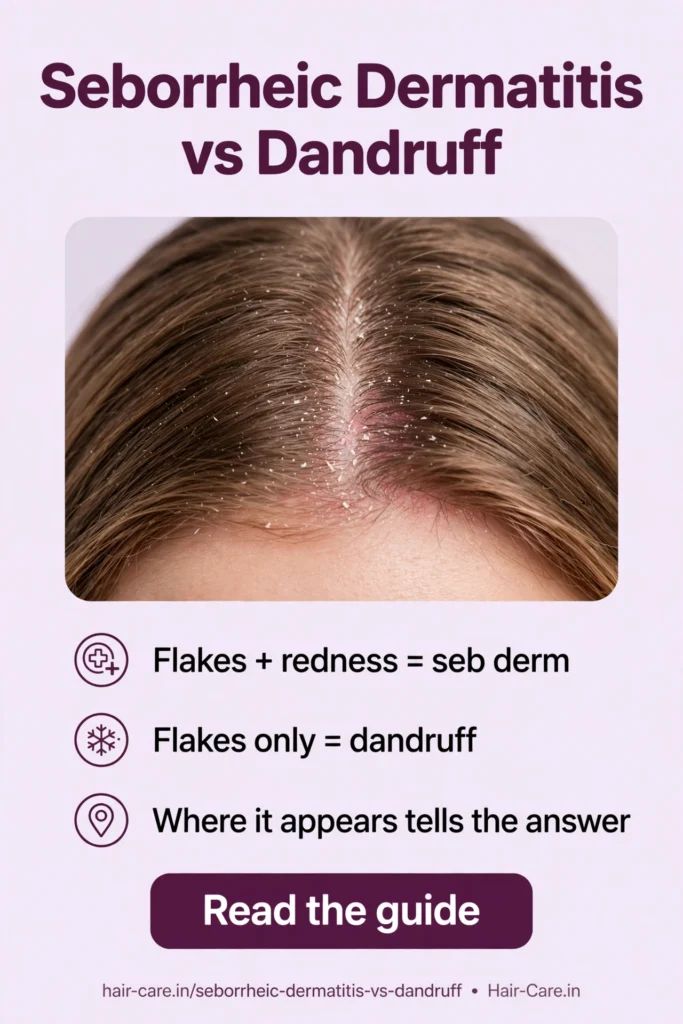
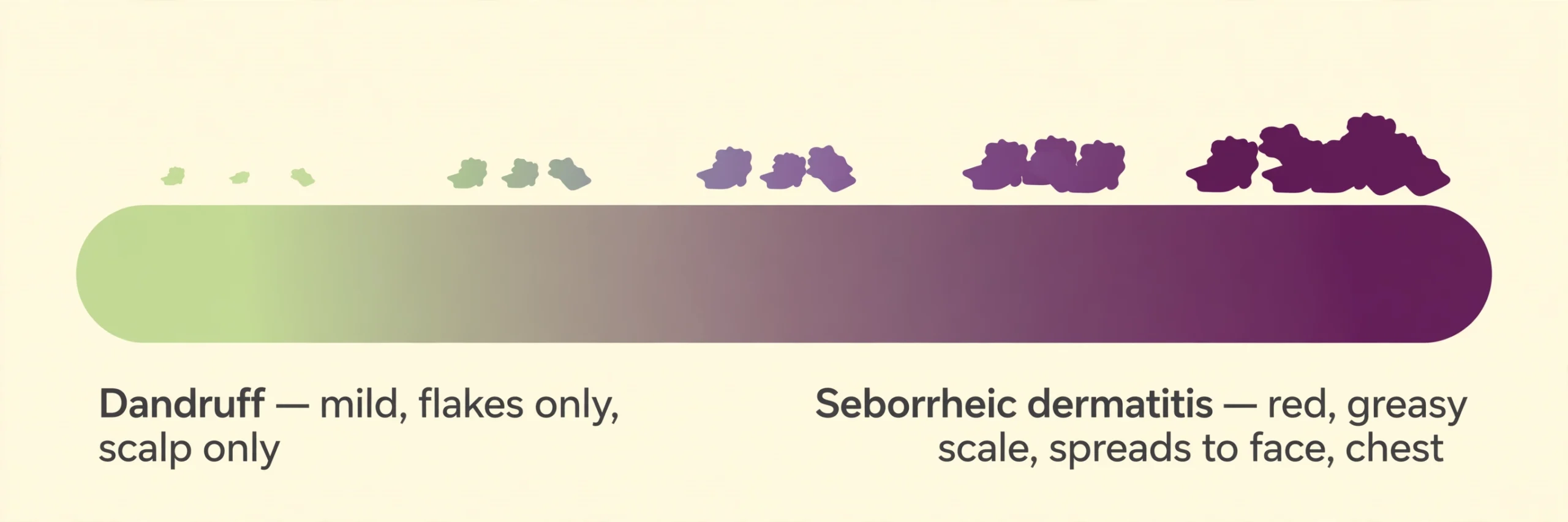
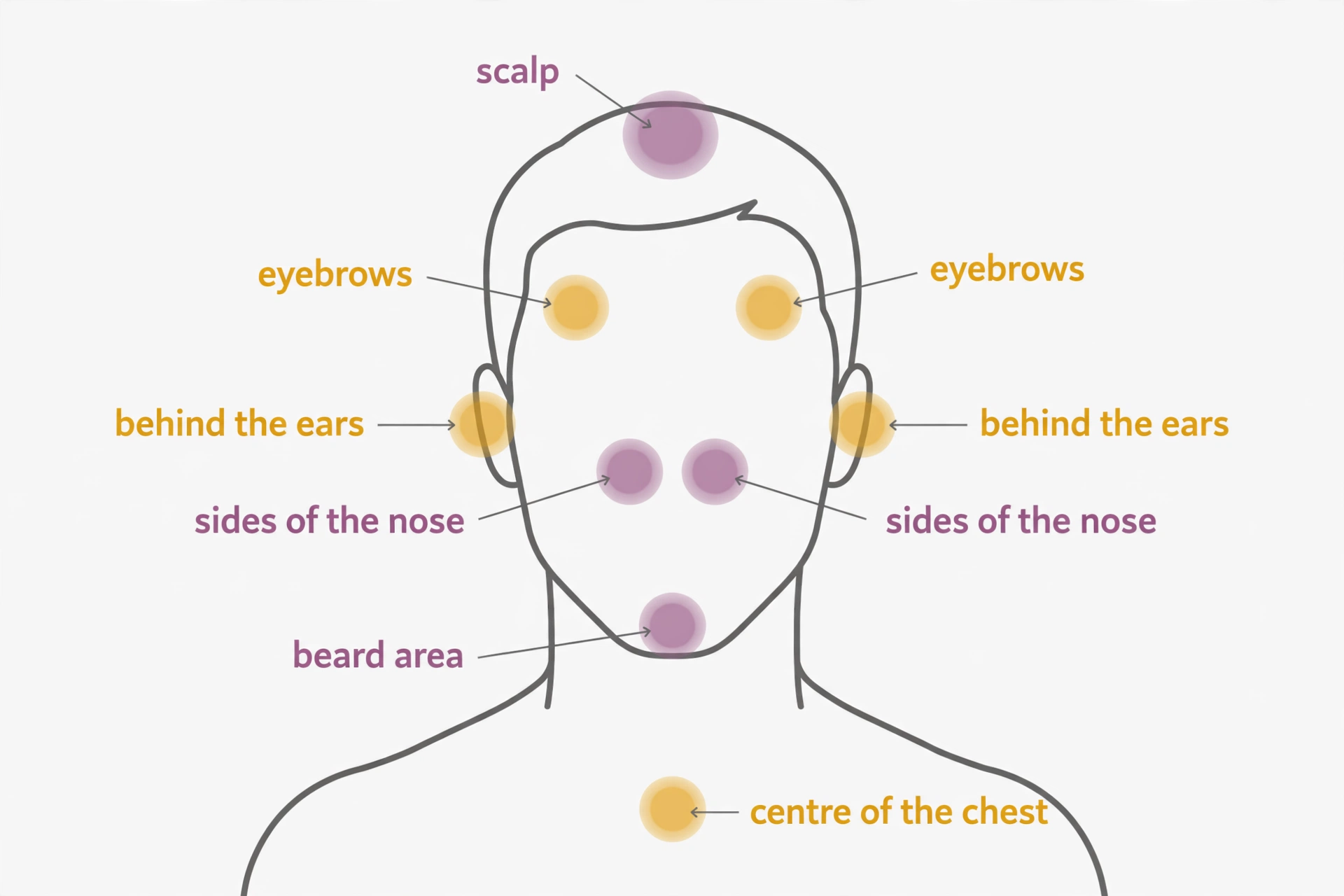
Dandruff and seborrheic dermatitis are two points on the same spectrum, not two unrelated problems. Dandruff is the mild end: fine, white or pale-yellow flakes on the scalp only, with little or no visible redness. Seborrheic dermatitis is the same process turned up: thicker, greasy, yellowish scale sitting on red or inflamed skin, and it can spread beyond the scalp to the eyebrows, the sides of the nose, behind the ears, the beard and the chest. The American Academy of Dermatology describes dandruff as possibly the mildest form of seborrhoeic dermatitis.
If your flakes come with redness, greasy yellow scale, or patches beside your nose and eyebrows, you probably have seborrheic dermatitis rather than simple dandruff. Either way, the first step is the same: a medicated shampoo with a proven antifungal active, left on the scalp for a few minutes. The difference is how strong the treatment needs to be, and when it is time to see a doctor.
As an Amazon Associate, I earn from qualifying purchases.
Dandruff and seborrheic dermatitis are the same spectrum
It helps to stop thinking of these as two separate diseases. Dermatology research treats dandruff and seborrheic dermatitis as one continuous spectrum of the same condition. Dandruff sits at the mild end: itchy, flaky, scalp only, no visible inflammation. Seborrheic dermatitis is the same process with inflammation switched on: scaly patches that are red underneath and can show up wherever the skin is oily.
The driver in both cases is a yeast called Malassezia. It lives on nearly everyone’s skin and feeds on the oil (sebum) your skin makes. In some people, the yeast’s byproducts irritate the scalp and speed up how fast skin cells shed. That is why dandruff flakes are not dry skin falling off — they are skin cells being shed too fast, stuck together with oil.
The Mayo Clinic puts it plainly: seborrheic dermatitis is a common skin condition that mainly affects the scalp, causes scaly patches, inflamed skin and stubborn dandruff, and usually affects oily areas of the body. The exact cause is not fully clear — it may be the yeast, excess oil, or a problem in the immune system. That uncertainty matters: anyone who tells you they know the single cause is oversimplifying.
Dandruff vs seborrheic dermatitis: the differences at a glance
| Dandruff | Seborrheic dermatitis | |
|---|---|---|
| Flakes | Small, loose, white or pale yellow, dry or slightly greasy | Larger, thicker, greasy, yellowish; sticky scale and crusts |
| Redness | None, or barely visible | Present — pink or red patches under the scale |
| Itch | Mild to moderate | Moderate to severe; can feel like burning |
| Where | Scalp only | Scalp plus eyebrows, sides of the nose, behind the ears, beard, chest, sometimes eyelids |
| Skin underneath | Looks normal | Inflamed, sometimes sore or tender |
| Course | Comes and goes; often controlled with a medicated shampoo | Chronic — tends to clear and flare again; needs maintenance |
No single row in this table decides the answer on its own. It is the pattern that matters: flakes plus redness plus spread beyond the scalp points to seborrheic dermatitis. Flakes alone, on the scalp only, with calm skin underneath, points to dandruff.
How to tell which one you have
You do not need a lab test to make a first guess. Three checks, done at home, sort most cases.
1. Look at the flake. Pick a flake off your shoulder and roll it between your fingers. Dandruff flakes are small, white or off-white, and slightly waxy because they are bound together with sebum. Seborrheic dermatitis flakes are heavier and greasier, yellowish, and sit in patches rather than dusting the whole head. If the scale comes off in a thick piece or a crust, that is more like seborrheic dermatitis.
2. Look at the skin underneath. Part your hair and look at the scalp where the flakes sit. Calm, normal-looking skin points to dandruff. Pink or red skin under the scale points to seborrheic dermatitis. This check is less reliable on brown or Black skin — more on that below.
3. Check where it appears. Dandruff stays on the head. Seborrheic dermatitis follows oil glands, so it turns up in the eyebrows, along the sides of the nose, behind the ears, and sometimes on the centre of the chest. A flaky scalp plus a flaky eyebrow is one of the more reliable signs there is.
The two-day root test. Wash your hair as usual, then wait two days and look at your roots. Visibly oily roots with flakes on top reads as dandruff or seborrheic dermatitis — an oil-and-yeast problem. Roots that look dry, with a tight feeling and fine powdery flakes, read more like a dry scalp, which is a different problem with a different fix (see the look-alikes below).
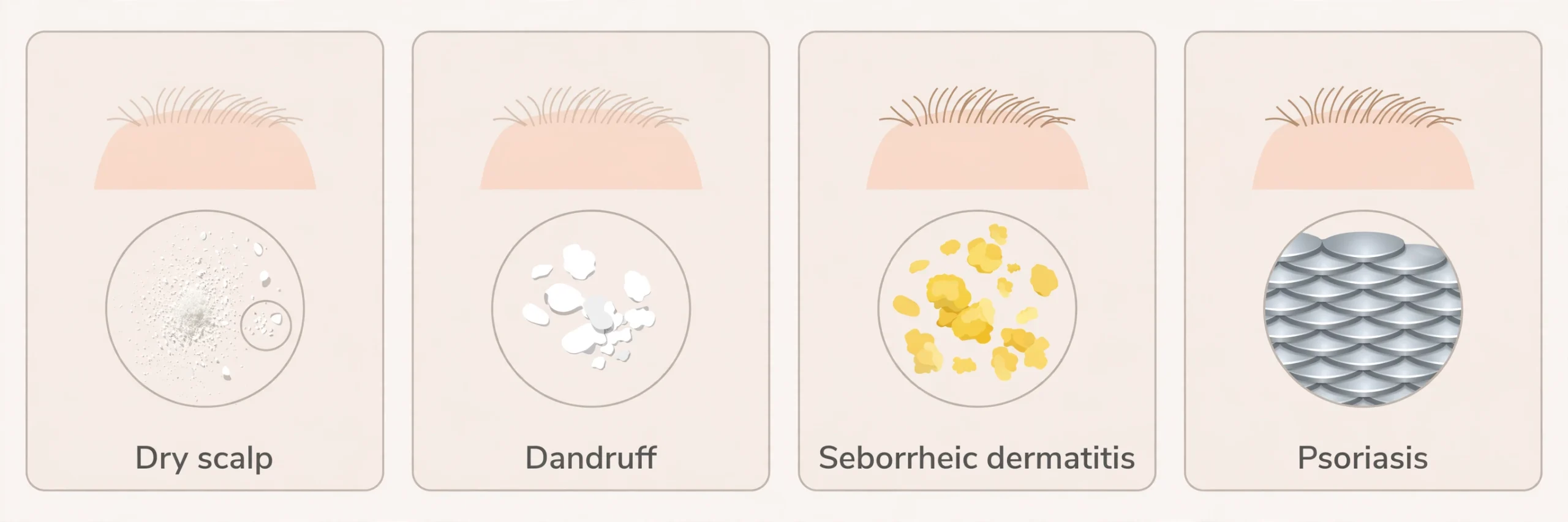
The look-alikes: dry scalp, psoriasis, and buildup
Flaking has more than two causes, and the wrong guess wastes months on the wrong shampoo. Here is how the common look-alikes differ.
| Flakes | Where | Oiliness | Itch | |
|---|---|---|---|---|
| Dry scalp | Very small, powdery, white; fall loose | Scalp, often with dry skin elsewhere (shins, hands) | Low — skin has lost moisture | Mild; skin feels tight |
| Dandruff | Small to medium, white to pale yellow, slightly waxy | Scalp only | Oily at the roots | Mild to moderate |
| Seborrheic dermatitis | Large, greasy, yellowish; sticky crusts | Scalp, eyebrows, nose folds, behind ears, chest | Oily | Moderate to severe |
| Scalp psoriasis | Thick, silvery, layered; lifts off in a sheet | Scalp, often crossing the hairline onto the forehead; elbows and knees too | Normal | Can be intense |
| Buildup | Clear or greyish shreds; looks like residue, not skin | Scalp and hair | Waxy, coated feeling | Mild |
Dry scalp is a moisture problem, not a yeast problem. It arrives with hot showers, hard water, cold dry air and harsh cleansers, and it usually improves when you switch to a gentler wash and add moisture. Dandruff does not improve with moisture — in fact, heavy oils can make it worse, because the yeast feeds on oil. That is the cheapest test there is: for two weeks, drop the harsh cleanser and add moisture. Real dryness improves. Dandruff does not budge, or gets worse.
Scalp psoriasis is an immune condition, not a yeast problem. The NHS notes that scalp psoriasis can look like severe dandruff, which is why so many people spend months on the wrong track. Its plaques are thick, silvery and sharply edged, and they often cross the hairline onto the forehead. If your flakes look like that, or you have similar patches on your elbows or knees, that is a doctor’s visit, not a shampoo change.
Buildup is residue from styling products, oils, dry shampoo or infrequent washing sitting on the scalp. It is not skin shedding at all, and the major medical references do not define it as a condition. A clarifying wash usually clears it; if the flaking returns within days, the scalp is producing it, and the cause is something else.
What it looks like on darker skin
Redness is the sign most guides tell you to look for, and on brown or Black skin it is the least reliable one. The Mayo Clinic notes that the rash may look darker or lighter in people with brown or Black skin, and redder in those with white skin. Seborrheic dermatitis on darker skin often shows as scaly, lighter patches in the usual places, plus ring-shaped or petal-shaped patches that look nothing like the textbook photograph.
So if your skin is brown or Black, do not rule out seborrheic dermatitis just because nothing looks red. Lighter patches under the flaking are consistent with seborrheic dermatitis, not evidence against it. The other checks — greasy yellow scale, itch, spread to eyebrows and nose folds — matter more than colour.
What causes both
Three things come together: oil, yeast, and the skin’s reaction to them. Your sebaceous glands make sebum. Malassezia yeast feeds on it. In some people, the yeast’s byproducts irritate the skin and speed up shedding. Stress, tiredness, a change of season and illness can flare it. It is not contagious, and it is not caused by poor hygiene — having dandruff does not mean the skin is dirty.
One more thing the research is clear about: dandruff is not caused by a dry scalp. That is one of the most repeated mistakes in hair care. Dandruff is an oil-and-yeast story; dry scalp is a moisture-and-barrier story. They need opposite fixes, which is why telling them apart matters before you buy anything.
Treatment: the ladder that works
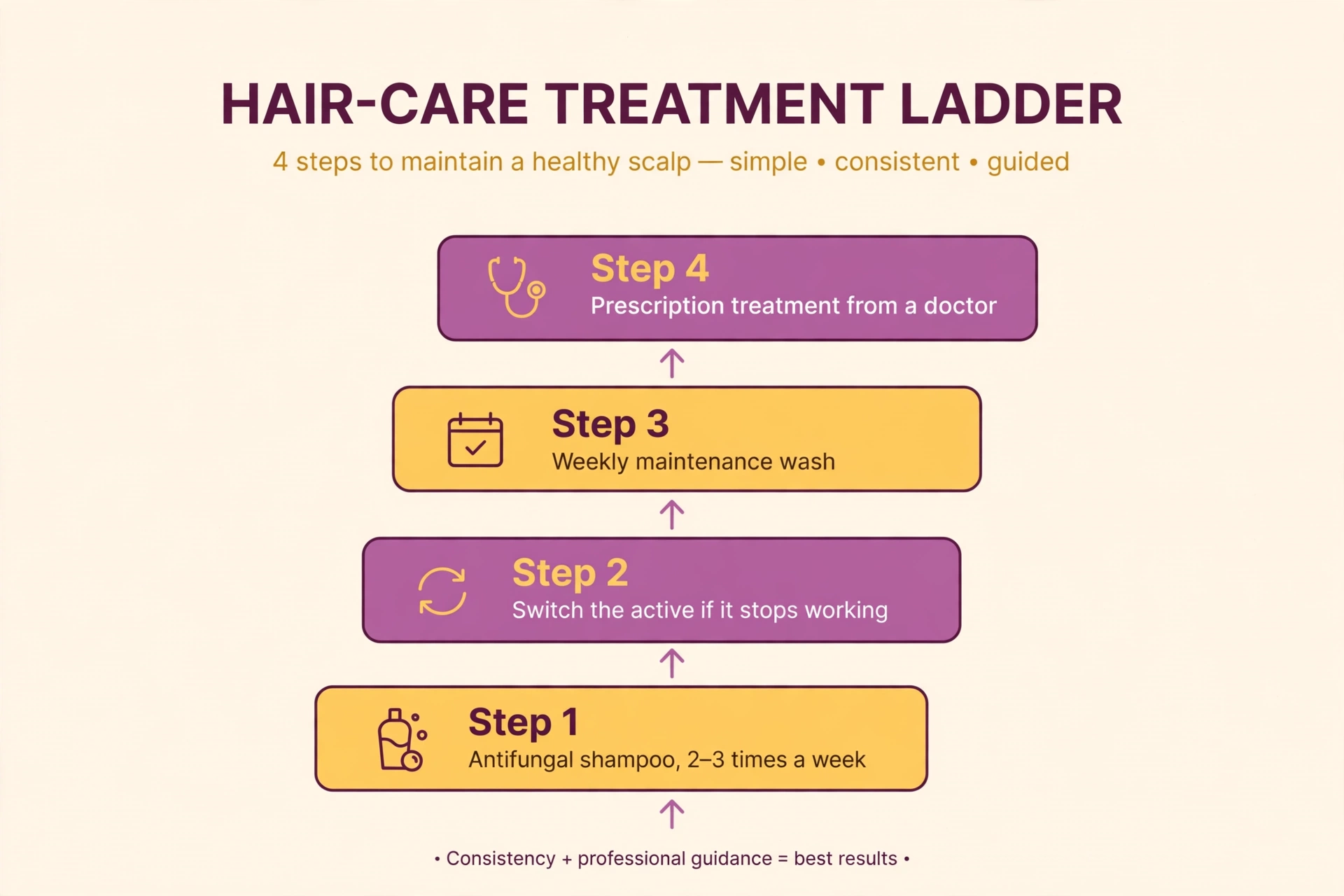
Treatment follows the same ladder for both conditions. You start low and step up only if the lower step does not work after a fair trial.
Step 1: an over-the-counter antifungal shampoo. The proven actives are ketoconazole (1% over the counter), zinc pyrithione (1%), and selenium sulfide (1%). Use it two to three times a week, and leave it on the scalp for 3 to 5 minutes before rinsing — the contact time is what lets the active work.
Check the current price on Amazon
For mild dandruff, this step alone is often enough. Our guide to how often to wash your hair if you have dandruff covers the wash schedule in detail.
Step 2: switch the active, not just the brand. If one active stops working, rotate to a different active — ketoconazole to selenium sulfide, for example — rather than buying another bottle of the same ingredient under a different label. The evidence backs this: in a 2002 trial of 331 people, ketoconazole 2% shampoo helped 73% of patients by week four, compared with 67% for zinc pyrithione 1% (PubMed 12476017). Both work; they just do not work equally well for everyone. Salicylic acid shampoos help when thick scale is the main problem, because they lift the scale so the antifungal can reach the skin. Coal tar slows skin-cell turnover and suits thick, stubborn scaling.
Step 3: maintenance, not stopping. This is where most people lose the result. In a 1995 trial of 575 patients, ketoconazole 2% used twice a week for two to four weeks gave an excellent response in 88% of patients — but over the next six months, relapse was 19% with weekly maintenance, against 47% with no maintenance (PubMed 7718463). The lesson is the same one in our post on why dandruff keeps coming back: flakes gone does not mean treatment over. Keep a maintenance wash once a week. A Cochrane review of 51 studies with 9,052 participants found ketoconazole 2% lowered the risk of treatment failure by 31% compared with placebo.
Step 4: prescription treatment. If over-the-counter shampoos have not helped after four to six weeks of correct use, a doctor can prescribe stronger options: ketoconazole 2% shampoo or cream, ciclopirox shampoo, or a short course of a mild topical steroid for a flare. Steroid creams calm a flare fast but are for short use, not daily maintenance — that is a decision for a doctor, not a shampoo aisle.
What does not work
- Heavy oils on a flaking scalp. Coconut oil, olive oil and similar heavy oils feed Malassezia. If your flakes are dandruff or seborrheic dermatitis, oiling the scalp is feeding the problem. (This does not apply to a genuinely dry scalp, which is a different condition.)
- Washing more and more. Over-washing strips the scalp and can make irritation worse. The fix is the right active with the right contact time, not more washes. Hard water can also make things worse — see how to wash hair in hard water.
- Scratching the scale off. It feels productive and it is not. It breaks the skin, invites infection, and the scale comes back.
- Skipping the maintenance wash. Stopping the moment flakes disappear is the most common reason they return.
When to see a doctor
See a doctor or dermatologist if any of these apply:
- No improvement after 4 weeks of correct use of a medicated shampoo (the NHS advises seeing a GP if dandruff does not improve after 4 weeks).
- The patches are spreading fast, oozing, crusting heavily, or painful.
- You have thick, silvery plaques that cross the hairline, or similar patches on elbows or knees (possible psoriasis).
- Hair is falling out in patches, or the scalp is swollen.
- The condition is on a baby (cradle cap is seborrheic dermatitis in infants and usually needs a paediatrician’s advice, not adult shampoo).
- You have a weakened immune system — seborrheic dermatitis is more common and more severe in that case, and it deserves medical care rather than self-treatment.
A dermatologist can usually separate these conditions in a minute by looking at the flakes, the skin underneath, and where the patches sit. That is the honest limit of any article, including this one: a guide can narrow it down, but only an in-person look can name it.
Video: a dermatologist explains seborrheic dermatitis
Watch on YouTube: Video by Dr Dray — “Dermatologist Explains How To Treat Seborrheic Dermatitis (Dandruff, Flaky Scalp, Eyebrows & Beard)” — https://www.youtube.com/watch?v=XiczXHrebEc
Dr Dray walks through what seborrheic dermatitis is, why it happens, and how to treat it with over-the-counter antifungal shampoos, coal tar, sulfur, salicylic acid, and short courses of hydrocortisone for flares. (Note: this video is embedded as a link because the YouTube embed does not load reliably on this site — the video itself is Dr Dray’s, not ours.)
Frequently Asked Questions
Is dandruff the same as seborrheic dermatitis?
Not exactly, but they are two points on the same spectrum. Dandruff is the mild end: flakes on the scalp only, with no visible inflammation. Seborrheic dermatitis is the same process with inflammation — red skin, greasy yellow scale, and spread beyond the scalp.
Is dandruff a mild form of seborrheic dermatitis?
Yes — that is how the American Academy of Dermatology describes it. Both cause white to yellowish scale that may be dry or greasy, and both are driven by the same yeast-and-oil process.
Can seborrheic dermatitis spread to the face?
Yes. It follows oil glands, so it commonly appears on the eyebrows, the sides of the nose, behind the ears, the beard and the centre of the chest. It is not contagious — it spreads across your own oily skin, not from person to person.
How can I tell dandruff from dry scalp?
Check the roots two days after washing. Oily roots with flakes on top point to dandruff. Dry, tight skin with fine powdery flakes — often with dry skin elsewhere on the body — points to dry scalp. Moisture helps dry scalp and does not help dandruff.
Does seborrheic dermatitis go away for good?
There is no cure for it, and the same is true of dandruff — the Mayo Clinic is clear that there is no cure for dandruff. Both can be controlled and kept quiet with the right shampoo and a weekly maintenance wash, but they tend to come back if treatment stops.
Which shampoo should I start with?
Start with an antifungal shampoo — ketoconazole 1%, zinc pyrithione 1% or selenium sulfide 1% — two to three times a week, left on for 3 to 5 minutes. If it does not help after four weeks, switch to a different active, and if that does not help either, see a doctor. Our ketoconazole shampoo guide explains how to use it step by step.
The bottom line
Dandruff and seborrheic dermatitis are the same problem at different volumes. Flakes alone, scalp only, calm skin — that is dandruff, and a medicated shampoo usually handles it. Flakes plus redness plus greasy yellow scale plus spread to the eyebrows or nose folds — that is seborrheic dermatitis, and it needs the same shampoo, used properly, plus maintenance and sometimes a prescription. The test costs nothing: look at the flake, look at the skin underneath, and check where it appears. And if four weeks of correct treatment has not helped, stop guessing and see a doctor — that is not a failure of the shampoo, it is the point where a look in person is worth more than another bottle.
Not a doctor’s note: this is a research summary, not medical advice. It explains what the evidence says so you can make an informed choice — and know when the right choice is a dermatologist.